

What is better for people and nature? That is the question I tend to bring to most rooms. It is the lens through which I think about funding, systems change and strategy. It was certainly the question I was holding as Johan Rockström joined the Environmental Funders Network’s Stepping Up discussion with UK funders.
“We are no longer this small world on a big planet. We are a very big world on a small planet that is actually showing signs of weakness.”
Johan Rockström
The world is changing. Rapidly. Seven of the nine planetary boundaries are breached. Major tipping points are approaching. The Earth system is showing signs of losing resilience. Those phrases can sound technical or distant. But their implications are not. If the systems that regulate our climate, soils, water and biodiversity become unstable, everyday life becomes harder and more expensive. Food security weakens. Heat and flooding increase. Insurance costs rise. Inequality widens. Public services strain. This is not a future scenario. It is a trajectory we are already on. Rockström was clear that this is a moment for leadership.
“You have to draw a line in the sand.”
That phrase stayed with me. In funding terms, ‘stepping up’ to meet the moment means drawing a line in the sand and being willing to support clear limits. It means backing work that phases out the most harmful activities and protects the ecosystems that still hold the line for us. It means investing in governance, legal reform and civic capacity that embed long-term stewardship into decision-making. Drawing lines is fundamentally about protecting stable living conditions for everyone. The future is not written, we get to choose.
Rockström also addressed a tension many of us have on our minds. We are already experiencing more extreme heat, flooding and disruption. Adapting how we live is essential. At the same time, emissions must fall sharply. He was unequivocal.
“You have to integrate these two and say, look here we’re moving towards dangerous levels of impact, so we need to adapt. But we also need to use that as a very strong political argument to accelerate the mitigation.”
We cannot choose between helping communities cope and reducing greenhouse gas emissions. If we focus only on ‘adaptation’, we lock in escalating risk. If we focus only on ‘mitigation’, we ignore current realities. In plain English – we need to change how we live to adjust to our changing climate and to stop fuelling environmental damage at the same time. But, and here’s the best bit, we can choose a path forward that reduces environmental harms and improves lives at the same time. We have an incredible opportunity to address historic inequity through fair action on climate change.
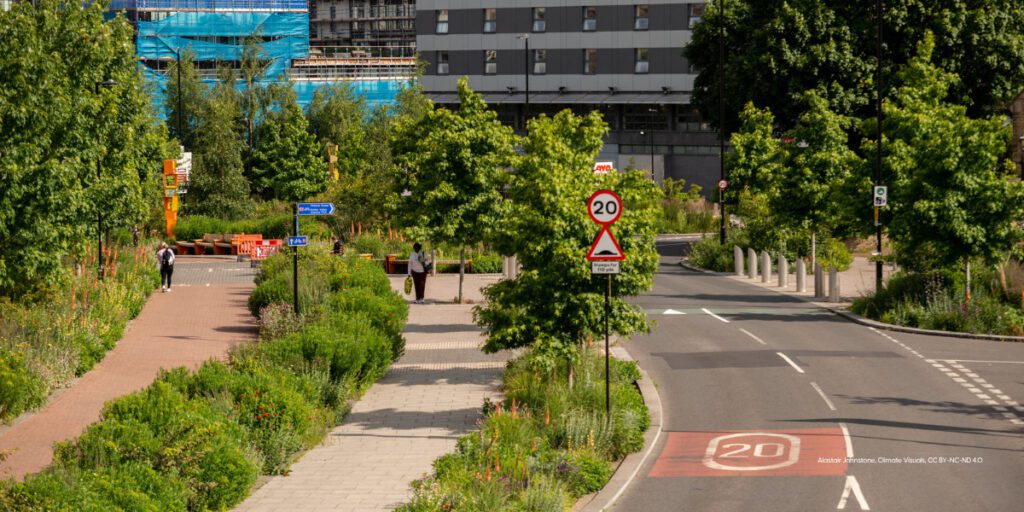
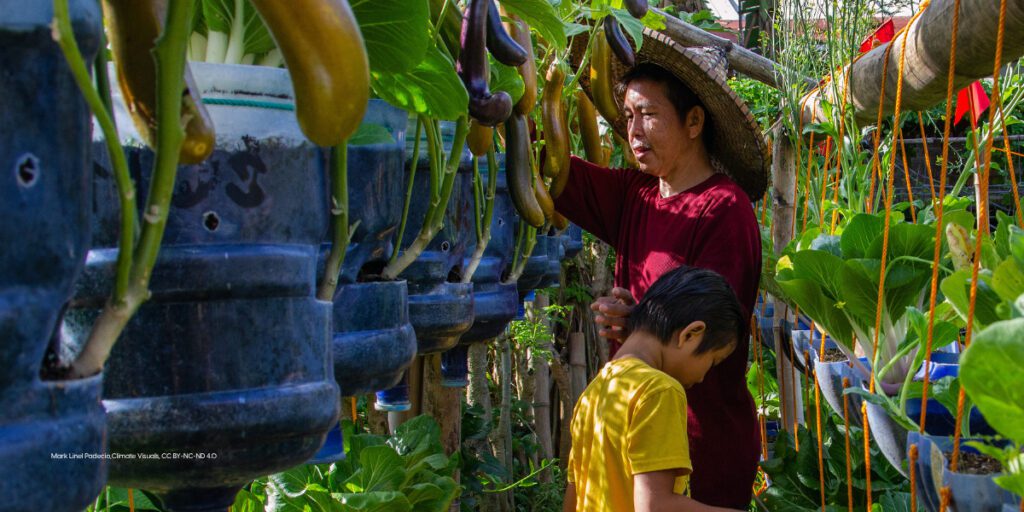
For funders, the opportunity lies in integration. Housing retrofit that cuts carbon and improves health. Community energy that reduces emissions and increases local resilience. Nature-based solutions that reduce flood risk and store carbon. Regenerative food systems that improve soil health and strengthen local economies. The list is long and the opportunities limitless if we step up to help shape them alongside communities.
When preventing things getting worse and adapting to the changes already underway move together, then outcomes are better for people and nature.
“All of this is an integral part of having stable living conditions.”
Clean air. Fresh water. Reliable food. Ecosystems that buffer storms and heatwaves. Access to green space that improves physical and mental health. These are not luxuries. They are foundations of health, security and dignity.
If we care about poverty, housing, disability, migration or racial justice – to name but a few – we cannot treat climate and biodiversity as separate concerns. And vice-versa, we can no longer ‘save the planet’ through environmental philanthropy alone.
The state of nature shapes the pressures households face. It influences health outcomes, cost of living and local opportunity.
“Sustainability is an investment towards a more prosperous and equitable outcome across essentially all sectors.”
That is not rhetoric. We see it in practice. Insulating homes reduces energy bills and respiratory illness. Cleaner transport improves air quality and access to jobs. Restoring peatlands reduces flood risk and protects water supplies. Urban tree planting reduces overheating and improves mental wellbeing.
These are improvements in quality of life. They are not sacrifices.
Rockström also reflected on the wider public conversation. The science has become clearer and more robust. The communication infrastructure has not kept pace.
“Science communication is, if anything, more important than ever.”
He described “a ridiculous misalignment between communication and science capability.” Research institutions are well equipped to produce evidence. They are far less equipped to ensure that evidence shapes public understanding and political will. At the same time, he noted something hopeful that so many of us hold onto:
“We are made to believe that we are in a minority if we care for the planet, when in reality, we are a majority.”
That matters deeply for philanthropy. If public concern remains strong, then funders have an opportunity to strengthen the space in which that concern can translate into action. That means investing in trusted messengers. Supporting community voices. Funding long-term communication capacity, not just short-term campaigns. Connecting global science to everyday experience in ways that resonate. Clearer stories about health, security, fairness and opportunity can shift public debate more effectively than abstract targets alone.
If I won the lottery and could fulfil my dream of being one of the world’s funkiest philanthropists, what would I fund? This ‘Stepping Up’ series conversation with Johan Rockstrom inspired me to want to get the climate scientists at the The Potsdam Institute for Climate Impact Research together with Climate Outreach and More in Common to build a version of Britain Talks Climate and Nature for the nine planetary boundaries. Wouldn’t it be amazing if everyone understood the opportunities to create a better future for people and nature by keeping within safe planetary limits?
That’s what I’d fund. What about you, what will you fund?
WATCH | Stepping up: in conversation with Johan Rockström
EFN members can watch back the conversation with Johan. EFN members have been emailed the password to this recording. If you cannot find the password, please email us to get the password to view.
Lead image: Local people collecting floating waterlilies in Kolkata, India. Photo credit: Shibasish Saha, Climate Visuals Countdown CC BY-NC-ND 4.0.