

In these turbulent times, social justice has become an increasingly urgent issue in philanthropy. It is fundamentally linked to the challenge of tackling climate change, insofar as the effects of climate change are disproportionately felt by marginalised communities already experiencing social injustices. To build a fairer, more equitable society, and to avoid climate catastrophe, systemic change is needed. Funders are increasingly recognising the need to invest in the communities who are fighting the systems that entrench both social and climate injustice, as well as their own role in upholding them.
The Civic Power Fund has partnered with The Hour Is Late to produce the third edition of research mapping social justice grantmaking in the UK, to see if funding flows are keeping pace with need, ambition and rhetoric. Funding Justice 3 analyses over 20,000 grants made by 84 funders during 2022/23. In this blog we present the main findings of this research, looking at social justice funding overall and for environmental initiatives specifically, and set out our key recommendations for environmental funders to deepen their impact.
Key findings:
1. Funding to tackle injustice is scarce.
The research reveals that grants directed to social justice were worth just £260 million1. This accounts for around 4.5% of funding from the UK’s largest grantmakers2.
2. Funding for community organising and power-building work is particularly lacking.
We know from historical and present day examples (some of which you can find listed in Chapter 3 of the report) that community organising is the surest way of addressing imbalances of power, and achieving sustainable social change. Community organising can be focussed on building power behind a specific thematic issue, like climate change, as well as in a specific local area. Parents for Future Scotland, Green New Deal Organising, UK Youth Climate Coalition, Friends of the Earth, Land In Our Names, Climate & Migrant Justice Organising Group and Tipping Point UK are just some examples of groups doing environmental organising work in the UK.
Given the importance of community organising we are very concerned that the funding for this work is so limited. Just 2.3% of the value of all grants analysed in Funding Justice 3 had organising at their core, equivalent to 0.2% of giving from the UK’s largest grantmakers.
3. Social justice grants are heavily weighted towards ‘service delivery’ work and ‘inside game’ initiatives.
As in the previous edition, we used six foundational theories of change to try and understand how funders are supporting social justice work, drawing on the work of the Ayni Institute.
We found that 46.9% of social justice funding went to ‘service delivery’ work, and 26.3% was directed to ‘inside game’ work, aimed at achieving change by influencing decision makers within the established structures of government and power3.
‘Structure organising’ and ‘mass protest’ theories of change together received less than 9% of social justice funding. This ‘outside track’ work tries to create change from outside the dominant structures of government and power, and is therefore the kind of work excluded communities rely on to be heard.
4. Social justice grants to environmental initiatives break down differently to the whole dataset.
When we analyse the grants to environmental initiatives across Funding Justice 2 and Funding Justice 3 we find 872 grants made in 2021/22 and 2022/23, together worth £67.7 million.
The breakdown of these environmental social justice grants in relation to the Ayni Institute theories of change is noticeably different to the breakdown for social justice grants on all issues (as summarised above). The ‘inside game’ theory of change received 51.5% of the funding, with work on ‘alternatives’ accounting for 23.7%. Support for ‘outside track’ work was somewhat higher than for the social justice grants in the round, with 12.2% of funding directed to a combination of ‘structure organising’ and ‘mass protest’ theories of change. This is encouraging, but it remains the case that the ‘inside game’ approaches received more than four times as much funding as the work that helps disadvantaged communities to build power outside of the dominant structures.
5. Social justice funding is still not reaching many local communities.
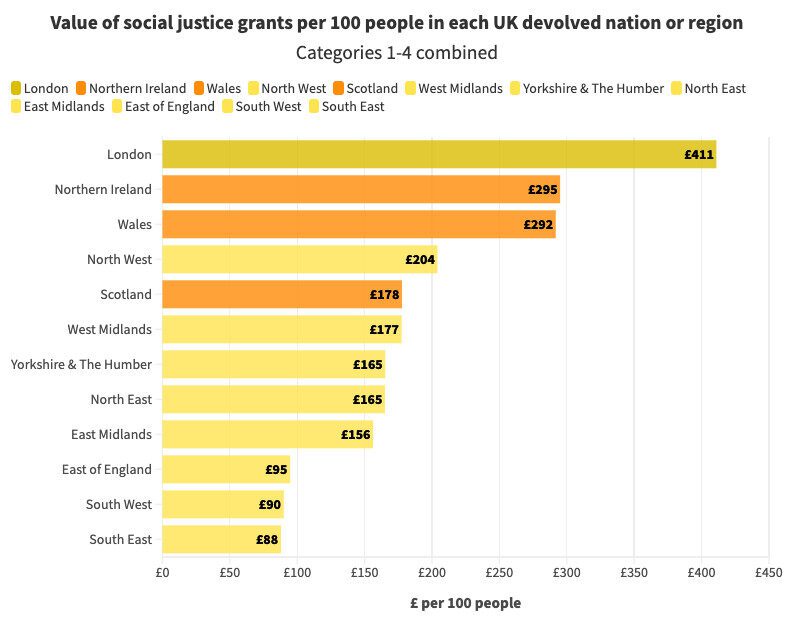
When we look at grants on all social justice issues, we found that 50.4% of social justice funding in 2022/23 went to work carried out at the national level. London continued to top the chart in terms of per capita funding, with £411 per 100 people.
The East Midlands, the East of England, the South West, and the South East were the regions that came bottom of the rankings in terms of per capita funding in both Funding Justice 2 and Funding Justice 3. These regions also fare poorly on environmental funding based on EFN research.
6. Social justice funding for environmental initiatives is reaching even fewer local communities.
The 872 environmental grants from Funding Justice 2 and Funding Justice 3 are even more concentrated on work at the national level, with 79% of the funding supporting organisations working nationally. When we express these environmental grants on a per capita basis, the three devolved nations, Northern Ireland, Wales, and Scotland, each receive more funding than regions within England, with London following in fourth place. As with the grants for the full set of social justice issues, the East Midlands, East of England, and South West are receiving the least per capita funding for environmental social justice initiatives, although the South East fares slightly better on this measure.
7. As in the previous edition, social justice funding was spread ‘wide and thin’.
The 3,871 social justice grants in our 2022/23 data went to 2,238 different organisations – an average of 1.7 grants per organisation. A third of grantees secured less than £50,000 in funding, and 23% received £10,000 or less.
In this edition, we began to build comparable, year-on-year data. Looking at the grants collected across three years of the research, we found that just 307 organisations had received a grant in all three editions of Funding Justice.
This scattershot distribution of grants has also been identified in EFN research on environmental funding, and contrasts with the approach of ‘radical right’ foundations who fund ‘movement ecologies’, support organising capacity, build long-term movement infrastructure, and engage in politics.
What environmental funders can do next:
Think about the approaches to change that you are funding.
Decades of historical evidence and recent experience tell us that ‘outside track’ work, particularly community organising, is an essential component of successful social movements. However, our research shows that social justice funding is disproportionately focussed on work alleviating the symptoms of injustice through service provision, or on effecting change in elite settings. If progressive movements, including those with environmental objectives, are to triumph over the politics of division, funders must dedicate more funding to grassroots community organising and power building work.
Take a longer-term, strategic view on effecting change.
When looking at the 84 funders in this edition of the research, they appear to be spreading their support across lots of different organisations. This wide and thin distribution is not conducive to building collective power and successful social movements over time. It also suggests a scattershot approach to funding, rather than one driven by a clear political strategy for achieving meaningful change. This contrasts with the way that the ‘founding fathers’ of UK philanthropy saw their work, and with how ‘radical right’ funders support their grantees today.
Furthermore, while ‘radical right’ funders have invested in key movement infrastructure for the long-term, we found that very few grantees have received support across all three years of our research. (Section B of EFN’s Where the Green Grants Went 9 report explores the contrasting approaches of ‘radical right’ and ‘progressive’ funders in more detail.) This risks leaving social justice funders struggling to navigate a political and rhetorical environment that has been stacked against them and their grantees. To avoid this, funders should direct their funding strategically to build the power of excluded communities over the long-term, and pool their funds with others to maximise impact.
Read Funding Justice 3 for further insights.
Footnotes
- These are grants that we consider fall within one of our four categories of social justice:
Category 1: “organising at the core” grants that focus on building power behind a specific thematic issue and grants focused on activism alongside grants supporting grassroots community organising, where local people set the priorities and plans of their organising work.
Category 2: “justice and power” grants where there is a clear concern for social justice and a focus on political or social change.
Category 3: “advocating for change” grants seeking to change policy, corporate practice, or social norms, but are less focused on the five principles of social justice.
Category 4: “justice rather than social change” grants helping communities facing injustice, but where the work is not strongly focused on social change. ↩︎ - It remains difficult to determine the denominator against which to compare the grants in our Funding Justice dataset. Since the previous edition, the Association for Charitable Foundation’s Foundation Giving Trends reports have been replaced by the launch of UK Grantmaking. We used their estimate of the grants made by the “Top 300 Foundations”, modifying that figure to take into account funders in our dataset that aren’t in the “Top 300 Foundations” group. Figures expressed as a percentage of “giving by the UK’s largest grantmakers” should be seen as indicative estimates. We hope to make them more precise over time.
↩︎ - For full definitions of all the categories we used in the research, please refer to the methodology section of the report.
↩︎