

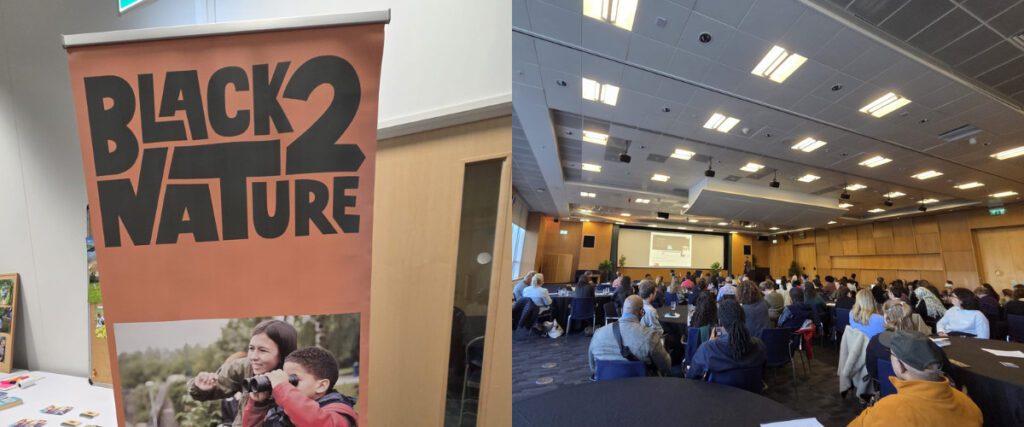
On Wednesday 3 December 2025, I had the opportunity to attend the Race Equity in Nature Conference 2025 at UWE Bristol — a day dedicated to equity, access, education pathways, and systemic change in the environmental sector. The conference was organised by Black2Nature, founded by Dr Mya-Rose Craig (Birdgirl), a British-Bangladeshi environmentalist who has been campaigning to diversify the sector for a decade.
What the day was really about
The event brought together leaders from major environmental organisations — such as the National Trust, RSPB, Friends of the Earth and Wildlife and Countryside Link — alongside researchers, EDI specialists, educators and grassroots practitioners. Speakers such as Chris Packham, Asad Rehman, Gillian Burke, Manu Maunganidza and many others spoke powerfully about structural barriers and the urgent need for inclusive pathways into nature-based careers.
A key theme repeated across the day was that representation is not just moral — it is strategic. Without diverse lived experience within organisations, nature-focused work will continue to fail to reach or resonate with communities who are disproportionately disconnected from the outdoors.
Key discussion & learning
Several conversations stayed with me:
Access pathways for BAMER young people into environmental careers: a panel explored how to widen opportunities for qualifications and training in conservation and environmental sciences, alongside workshop discussions on inclusive internships, accessible degree recruitment, and awareness-raising among Black, Asian, Minority Ethnic and Refugee (BAMER), parents and communities.
The importance of culturally relevant engagement: the conference highlighted examples where young people from urban environments experienced nature meaningfully for the first time — from birdwatching to star-gazing. Black2Nature shared how teenage boys were astonished to see Jupiter and its rings with the naked eye — a formative, perspective-shifting moment.
Data and accountability: the RACE Report findings were revisited, demonstrating persistent under-representation of racially minoritised people across environmental professions. I was struck by the clarity that data is not for blame — it is for direction.
My personal reflection
I want to acknowledge something honestly: I am normally the only BAME man present at such conferences. Walking into spaces like this with such a diverse attendance was amazing for me — full of passionate, well-meaning people, yet still visually and structurally homogenous — brought mixed feelings. There is pride in being present, but also a reminder of how far we still have to go at other similar events.
Another observation hit me: so many of the BAME-led organisations or individuals doing frontline engagement appear to be based in the North — Manchester, Bradford, Leeds — whereas the professional sector conferences, senior environmental roles, and charitable administrative leadership still feel concentrated in the South. This geographic inequity is something we rarely discuss, but it shapes networks, funding access, and visibility.
Being a new fundraiser — and what I’m learning
As someone new to fundraising — and not yet a full-time specialist — I found it powerful to hear from organisations that have built programmes from the ground up. Learning how Black2Nature scaled from its founder’s passion to a decade-long movement, as I reflect on Become United mobilises community-centred models in Greater Manchester.
I realised something important: fundraising for equity work is not just about money — it’s about translating lived experience into institutional urgency. I’m still developing the language, the confidence, and the frameworks — but attending this conference sharpened my sense of purpose.
“Fundraising for equity work is not just about money — it’s about translating lived experience into institutional urgency.”
Key takeaways that will inform our work
- We must normalise nature for every community — not as an occasional “access initiative”, but as a sustained presence.
- We need visible role models across the sector, not just for young people, but for colleagues within organisations.
- Funders need to support relationship-based, community-led programmes, not just transactional project-based outcomes.
- Collaboration between big national organisations and small grassroots ones must deepen, ensuring not just consultation, but co-creation.
- We need bolder structural change: recruitment reform, leadership diversification, paid entry points, widening access to relevant education — not just awareness campaigns.
The day left me with a mix of hope, urgency, and responsibility. Change is happening — but slowly — and only because people continue to show up, speak up, and push forward. I left the conference feeling more connected to a network of organisations and individuals doing the work with sincerity and lived commitment.
As I continue learning, fundraising, and building relationships in this sector, I’m taking forward a very clear message:
Diversity is not a problem to be solved — it is an asset to be centred.
Connect with us
If you’re interested in partnering with Become United or learning more about our work supporting People of Colour and underrepresented communities, please visit www.becomeunited.org.uk/ or contact Mohammed.