

Evaluation is often viewed as a purely technical exercise – a world of spreadsheets and percentages. But when you’re working on topics like leadership development, the numbers only tell part of the story.
Last year, Bright Impact CIC was delighted to be selected as the Learning Partner for the Leadership Labs project in Scotland. The 6-week leadership development course, jointly delivered by I.G Advisors and Environmental Funders Network (EFN), is all about how we support senior leaders operating in the climate, environment and natural heritage sector. Funding from The National Lottery Heritage Fund is supporting three cohorts (each of around 20 people) to receive free training on self-leadership, operations, strategic influence alongside Action Learning Sets.
With the third and final cohort in the pilot programme just getting underway, we want to share some of our learning so far about the approach, the impact and what participants in the first two cohorts have valued most. We hope it provides some useful food for thought about the value of investing in leadership in the climate, environment and natural heritage sector.
The evaluation approach
We love this type of evaluative work – it’s about people, relationships, learning and impact! The I.G and EFN teams were clear from the outset that they wanted to learn about what isn’t working, as much as celebrating what is.
So our ambition is to collect data that allow us to:
- Get feedback on participants’ experience so the team can learn and iterate
- Track progress against some key outcomes
- Centre the voices of participants and bring impact of the Labs to life
To achieve this, we designed a mixed-methods evaluation approach, weaving together standard methods like surveys and focus groups with more creative methods like poetry:
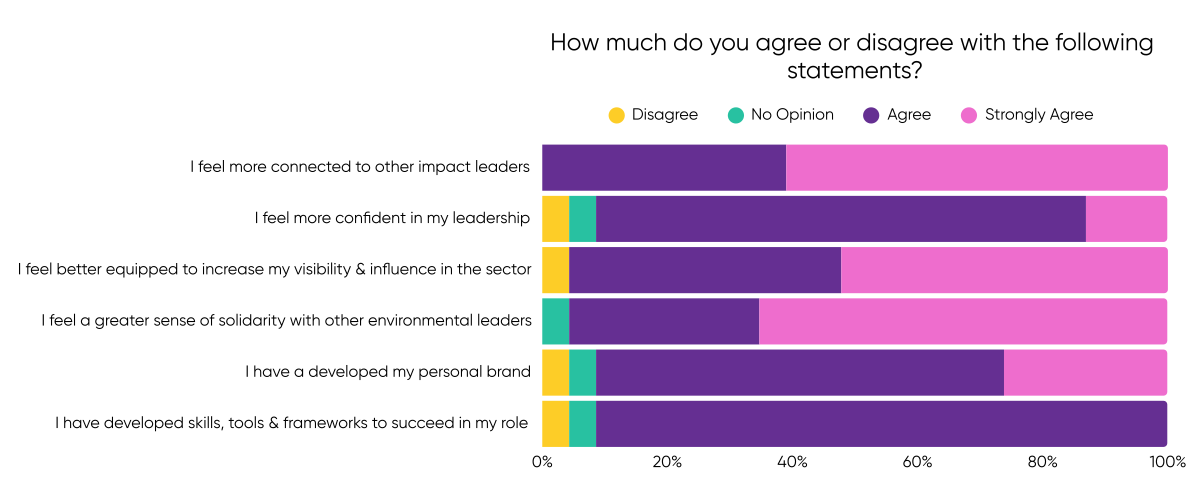
Method #1 The post-lab survey – we’ve developed questions that relate to key programme outcomes, including confidence, skills, connections and solidarity. We also ask for feedback about the Lab, what participants enjoyed and ideas for improvement.
Method #2 Focus group discussions- we picked out some of the key themes emerging from the post-lab survey and asked open questions to the participants. Where we had a small number of participants, we discussed in a group and where we had more participants we used an online mural board to collect ideas and then asked questions around those.
Method #3 Poetry – we’ve experimented with a couple of different ways of using poetry in the focus groups. One followed a fairly structured approach to create this collective poem which we then explored with participants.
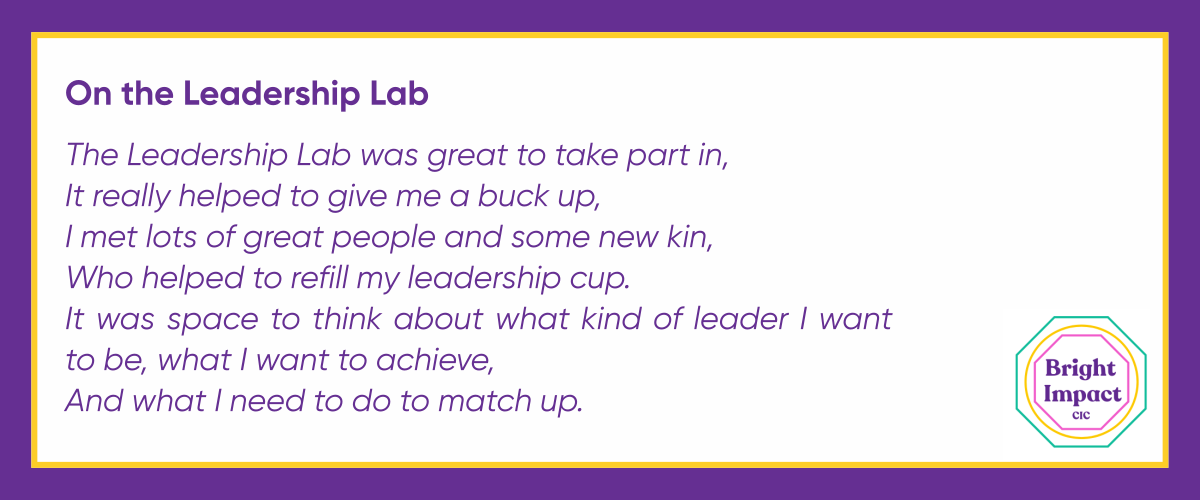
The second time we created a found poem based on post-it notes on a mural board about what leaders need from funders, and used it as more of a communication tool.
Key impact finding: everyone took something from the Lab
At the end of the 6 weeks, the data show that everyone took something from participating in the Lab – in particular, everyone felt more connected to other impact leaders!
Other key stats include:
- 96% feel a greater sense of solidarity with other environmental leaders
- 91% feel more confident in their leadership
- 91% developed their personal brand
What participants valued most
“The environmental sector is very project-based so most people are used to working very independently. The lab’s helped with feeling we’re all part of the same team”
Across both cohorts, several themes emerged from the qualitative data about what participants valued:
- Connection and solidarity: Leadership can be lonely. The Labs provided a space to share experiences and build a sense of collective belonging. Leaders explained it was unusual to talk about leadership rather than the topics they addressed within their organisation. This helped with feeling less alone and many leaders felt it contributed to reducing imposter syndrome because they could see other leaders were facing similar challenges. It also allowed them to connect with leaders outside their ‘direct networks’.
- Reflective space: The time to think about and reflect on leadership. Participants valued the opportunity to explore their core values and align them with their leadership style. Participants reported feeling that the Action Learning Sets provided a “unique opportunity” to bring a live issue they were facing and have time to reflect with others on the best way to proceed.
- The Toolbox: Having access to a curated set of resources to “dip in and out of” provides practical support after the Labs finish. Many participants talked about the sessions and resources around personal branding in particular. Focus group discussions explored how this was often an uncomfortable topic and the lab did a good job of unpacking it and highlighting the importance of it for leaders.
- Culture and facilitation: The ‘vibe’ matters. The welcoming, relaxed culture created by the I.G team, combined with high-quality facilitation, allowed participants to show up as themselves.
‘I think [personal branding] is just something that I hadn’t really thought a lot about before and it’s one of those things that’s a nice extra to do or something you do if you’ve got time. But I think it really did get through to me that if you’re going to be a leader and you’re going to represent your organisation and yourself externally and you are going to try and attract funding or new members then you do need to put yourself out there and you need to show people what you’re about and present that strong public-facing image so it does need to be really embedded in your role.’
Learning and iteration
Understanding impact in this context isn’t just a case of measuring cause and effect, and as evaluators, we have to embrace a degree of messiness. Our approach to evaluation was designed to capture this – rather than waiting until the end of the project, we’re exploring the learning at the end of each cohort.
By capturing what is working – and just as importantly, suggestions for improvement – we have been able to feed those insights directly into the next cohort. So far, this approach has enabled the team to make small, practical tweaks between the cohorts, such as adding in breaks, featuring more guest speakers from Scottish environmental charities, and creating more space to explore real-life challenges.
While this approach makes it difficult to directly compare the results across the cohorts in a strict scientific sense, it reflects our commitment to iterative learning. To maximise the utility of evaluation, these sorts of trade-offs are often necessary.
Next Steps
In terms of what’s coming up, we’re in the process of scheduling interviews to understand longer term outcomes for both the individual leaders and their organisations. We want to know what, if anything, they have put into practice and how this learning is helping them create positive environmental impacts.
We’re also planning for the final cohort evaluation and will hopefully have the final highlights to share some time in May. As we move forward, we continue to learn that evaluation isn’t just about proving value – it’s about improving it. We look forward to sharing more as these leadership journeys continue to unfold.
“The opportunity to have [the course] fully funded was amazing because it’s something I would never normally be able to do. And it just seemed to come at a good moment where I’ve been thinking about personal development and leadership training. So it just sort of fit really well with what I needed at the time.”
Get in touch
If you’re interested in how creative approaches to evaluation could help your organisation, then please visit www.brightimpact.co.uk or contact Jami.
For any questions about the Leadership Lab itself, please contact Sophie and Caitlin.
Finally if you are a senior leader in the environment sector, are excited by this programme and would like to take part, please get in touch with Julie Christie. We have a growing waiting list and, pending funding bids, we hope to offer Leadership Labs in Scotland and beyond.