

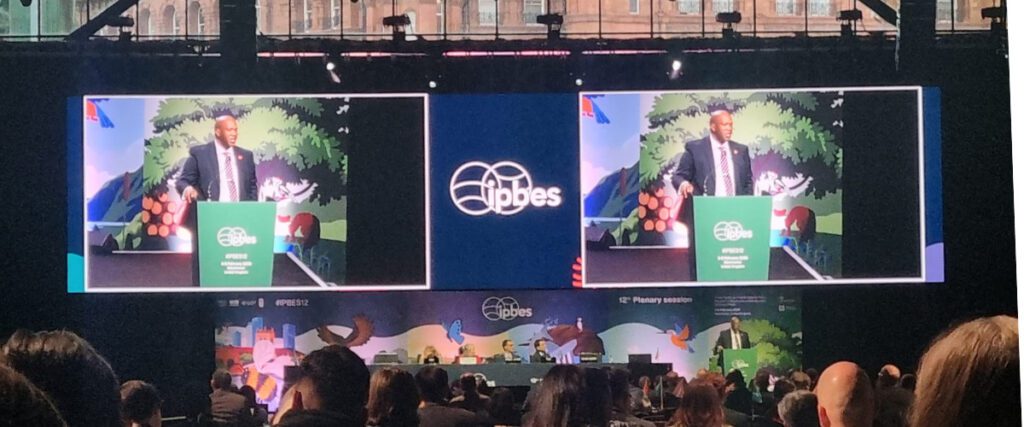
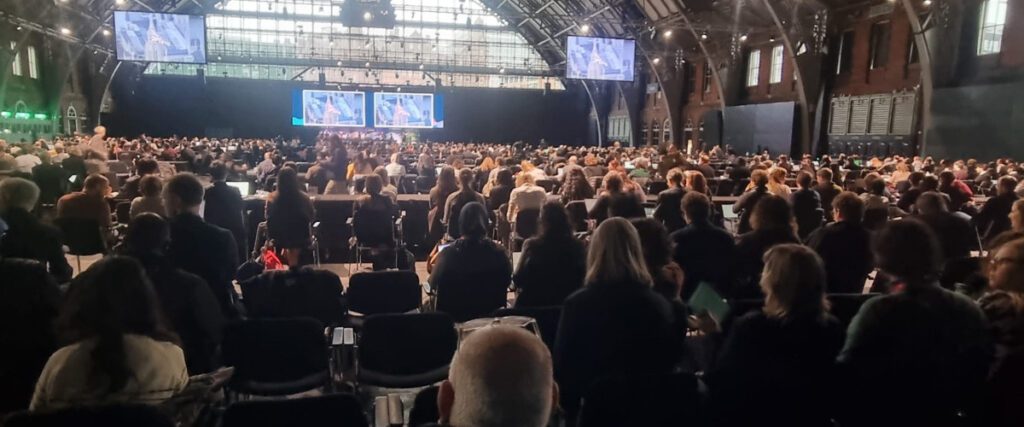
At the start of February 2026, we – Oscar Brenneke-Dunn and Aliyah Green – attended the IPBES 12th plenary meeting in Manchester, UK. IPBES is the Intergovernmental Science-Policy Platform on Biodiversity and Ecosystem Services, and is similar to IPCC but focused on biodiversity. At the plenary meeting, different stakeholders, including international government representatives, scientists, Indigenous knowledge holders, and NGOs came together with the main aim of reviewing the new Business and Biodiversity Assessment. Find a recording of the media launch here. This assessment highlights businesses’ dependency on nature, aims to reduce businesses’ negative impacts on biodiversity and provides guidance on how to do this.
Below we share our key reflections and takeaways from our experience, including some prompts for funders to consider at the end:
Oscar’s reflections
The tedium of international negotiations is a happy place. At IPBES I felt a sense of collective action, collaboration and trust in scientific research and knowledge. It was a refreshing contrast to the discourse of international relations we see reported in the media. IPBES wasn’t a space of hard power, hegemony and superpowers. Consensus ruled, and was founded on a mutual respect for the expert panel guiding the process.
“We agreed that key message in record time” announced the chair of a working group. The statement was met with laughter from the room. It had taken over four hours to agree the wording of two paragraphs.
It would be easy to feel jaded by this process. Like so many working in the environmental space, I’m constantly aware (and terrified) by the urgency of the climate, nature and pollution crises we face. Forums like IPBES feel slow, bureaucratic and pedantic. The need for consensus acts as a blocker to more radical ideas, and provides an opportunity for deliberate ambiguity and limited acknowledgement of the interconnection between the crises of our age.
Yet, I left the conference feeling that spaces like this are quietly revolutionary. 150 countries coming together to agree on and approve the assessment. Regardless of the stance of their political leadership, countries were not denying, delaying or undermining the need for action. Participants were looking for common ground, not trying to highlight division. And perhaps most surprisingly of all, there was a real acknowledgement that expertise doesn’t just come from people with letters after their names and academic qualifications. In the drafting of the assessment and in the conversations that surrounded it, space was consistently made for Indigenous Knowledge and local realities.
Of course, I recommend that you read the published assessment and make up your own mind about its quality, relevance and potential usability. I think in many cases, as someone working directly in the environmental sector, you will be left wanting. However, I can’t emphasise enough how remarkable I found the process that brought it into being. The dedication, the attention to detail, the compromise and the good will.
“I left the conference feeling that spaces like this are quietly revolutionary. 150 countries coming together to agree on and approve the assessment. Regardless of the stance of their political leadership, countries were not denying, delaying or undermining the need for action. Participants were looking for common ground, not trying to highlight division.”
However, I fear that the story from IPBES might not be the successes of the agreed assessment, but the absence of the USA. “Drill, baby, drill”, a slogan that has bled into foreign policy, feels like the antithesis of the evidence backed consensus we spent a week immersed in.
My key takeaway from IPBES 12 isn’t around the output or content, but a question, “how do we create more spaces like this?”. It felt like an antidote to polarisation. A testament to thoughtfulness. I have left renewed in my belief in the need for citizen’s assemblies.
Aliyah’s reflections
Like Oscar mentioned, the conference aimed to include Indigenous wisdom and peoples in the decision making process by including stakeholders called ‘Indigenous Knowledge holders’. Although critiques were shared that more should be done, I believe this should be standard practice in environmental justice work: learning from Indigenous perspectives, collaborating with Indigenous Knowledge holders, and understanding how frameworks we implement are rooted in Indigenous wisdom.
I also appreciated the conference’s efforts to be accessible in some ways. Translation services were provided, space was created for country representatives to share their thoughts and ask for clarification, and technical language was explained or simplified. It was refreshing to enter a completely new environment yet be able to follow and engage with most of the conversation. With funding spaces often inaccessible to those who do not work in the sector, it left me wondering, ‘what more can be done to make spaces in our sector more accessible?’
While the assessment discussed throughout the conference provides insights into businesses’ impacts and dependencies on biodiversity, for me it points to the need for deeper, more transformational approaches to economic change in order to address environmental crises. There is much work that needs to be done and there are already many actors working on this – one is the Fertile Ground report commissioned by Partners for a new economy, which aims to map and analyse Europe’s new economy ecosystem.
“It was refreshing to enter a completely new environment yet be able to follow and engage with most of the conversation. With funding spaces often inaccessible to those who do not work in the sector, it left me wondering, ‘what more can be done to make spaces in our sector more accessible?’”
The conference connects to a larger question I constantly consider: what needs to be done to transform our economy to tackle environmental and social crises? Something which EFN also considers, currently with our Stepping Up series including experts such as Kate Raworth and Robin Wall Kimmerer, both who talk about just economic systems.
The key thoughts I was left with after IPBES 12 are around creating accessible processes and spaces within the funding sector, collaboration with Indigenous Knowledge holders and the need to understand economic transformation as fundamental to tackling environmental crises.
Prompts for funders
- How do we create more patient spaces that balance finding common ground with scientific expertise? Can the approach of IBPES be translated into Citizen’s Assemblies or similar spaces that build consensus and action plans?
- How do your practices as a funder or an individual donor relate to wider economic transformation – whether that’s looking at your investment portfolios, funding strategy or grantmaking priorities?
- How are you learning from Indigenous knowledge and perspectives? How are you collaborating with Indigenous Knowledge holders in your work? This learning does not need to happen alone – check our EFN’s next Book club, we are reading The Serviceberry by Robin Wall Kimmerer on the gift economy and Indigenous perspectives.
We’d love to hear what any of our members thought about IPBES 12 and the final business assessment. Also if going to conferences like this and providing feedback for the network is useful? Let Aliyah or Oscar know via email.