
“We are in the midst of a rupture, not a transition” said Mark Carney, Prime Minister of Canada . In response, American writer and activist, Rebecca Solnit, calls for a“reconstruction” that doesn’t “return to the way things were”. She imagines a future that is “more democratic, more egalitarian, more generous [which will] serve all of us – and nature and future generations too”
The great rupture is already asking a lot of philanthropists. Sudden withdrawals of major public funds, like USAID, have created imminent threats to lives and ecosystems. Philanthropy is stepping in, not standing by. But how can we – the community of philanthropists and innovative problem solvers – move from fighting fires to igniting long-term renewal?
I’ve had the privilege this decade of sitting between the two worlds of donors and innovators. Overseeing The Earthshot Prize global search for inspiring NGOs, start-ups and policymakers, I’ve heard from thousands of innovators. Their collective message is that many conditions needed for renewal are at our fingertips. We have invented much of the technology that renewal needs. Innovators around the world can swap ideas at the touch of a button. Innovator’s visions of renewal are vibrant and realistic. They imagine forests that can raise funds for their own restoration, universal renewable energy access, stringent pollution controls that actually save businesses money, and coastal livelihoods that provide for families while protecting the oceans.
The intent to realise such visions appears to be shared across philanthropy and innovation. From both sides there is a belief that philanthropy will be the vital catalytic spark to ignite this renewal. But rupture is rapid and the opportunities to orient towards a just transition may fade as quickly as they arise. How do we seize the moment?
Innovators suggest five tactics for accelerating systemic renewal that deserve exploration
1. Invest in the mortar between the bricks
Lets visit the banks of Lake Victoria in Kenya, where tilapia fishing and pineapple farming coexist with unique wildlife sites, and locals enjoy the boat races, feasts and music of the annual Rusinga Festival. Pieces of the future are emerging. Cloth made from pineapple waste. Renewable refrigeration that stops the current 50% loss of fish catches. Well equipped community health services. Domestic energy systems replacing polluting cooking stoves and paraffin lamps. This Kenyan community is being served by dozens of innovators who see a future of renewal, each one a brick in the road to the future.
But I heard from them that each NGO or start-up is independently hitting the same hurdles. Challenges included supply lines, talent, funding, technology access and routes to market. Could the mortar between the bricks be the key to a stronger road? What if the community of NGOs and start-ups could afford to set up an “Agency for the Future” acting for them as a collective? It could organise microfinancing, address policy barriers, upskill potential local recruits, source routes to market and boost supply chain resilience. The Association of Countrywide Innovation Hubs has over 150 members in rural Kenya alone, each one a hub supporting grassroots innovations to grow. The innovators that need our funding are out there, and so too are the hubs that can support their growth. For each innovator funded, could some philanthropic funding also be dedicated to a collective community support hub?
2. Fund those with lived experience and traditional knowledge
The wonderful peace activist Ilwad Elman delivered a stunning call to action at the 2026 Change Now conference in Paris. She declared, Somalia’s peace, economic development, health, education and environmental protection cannot be achieved by agencies parachuting in to work on one issue in isolation. Elman’s Drop The Gun, Pick Up The Pen programme supports child conscripts to escape militarism and live lives that build every aspect of a stronger Somalia. Around the world, the lasting progress I’ve seen comes from local leadership with lived experience. Indigenous-led seed banks and decades-old protected territories in the Amazon. Maori campaigners achieving rights for nature. Maasai leaders securing tenure over ancestral lands where pastoral lifestyles steward nature and provide for people. Putting funds into the hands of the people who live with the problems and chart a brighter future for their community has proven to be effective around the world.
3. Philanthropists and innovators make a perfect team for taking risks
Trillions of dollars will be needed to complete the transition to renewal. Only commercial capital markets and governments can provide that level of investment. But that will only arrive when returns and outcomes are known and likely. At a time of rupture, opportunities arise and fade rapidly, and the winning approach to creating change is often unclear. What we need is rapid experimentation, learning and iteration. This is the perfect task for innovators and philanthropists, who can see the landscape, chart the opportunities, ideate new tactics, and apportion funds swiftly. Innovators see philanthropists as the perfect partners to react with vision and imagination to the opportunities for renewal in the time of rupture.
4. Measure progress, not just planting
The most common message from innovators is that impact measurement unintentionally stifles innovation. The great renewal is about changing systems that improve lives and ecosystems for generations. In reality, this means negotiating the High Seas Treaty, achieving EU microplastic regulations, legal challenges to fossil fuel extraction, and securing indigenous land rights. Before the ultimate prize is won, these advances are measured by the size of alliances, pledges of governments, and new stepping-stone legislation. Even in more metric-friendly pursuits like bringing renewable energy to every home in Africa, the big unlock isn’t the number of units installed in a year. The transformative step looks more like arranging $250m of microfinancing to make clean energy affordable for hundreds of thousands of families.
Innovators often feel pushed to deliver immediate quantified metrics – CO2 saved, tonnes of waste eliminated, trees planted – but they would rather see philanthropists as partners in the lengthy journey. They want to share the mission and the journey, and brainstorm tactics together., We might still want to track metrics, but hearing about and seeing progress by working with innovators brings many benefits. It enables philanthropists to paint much more vivid pictures of how their resources are driving real change, it brings much more intelligence on the issues, and also makes the adventure of being a philanthropist a much more compelling journey.
“At a time of rupture, opportunities arise and fade rapidly, and the winning approach to creating change is often unclear. What we need is rapid experimentation, learning and iteration. This is the perfect task for innovators and philanthropists.”
5. Catalyse billions from commercial and government sources.
We’ve established that commercial and public capital is needed to achieve major change like constructing disaster-resilient housing across Asia, or preventing coral reef extinction. We discussed that philanthropists and innovators can take the risks together that prove new approaches are viable for commercial or public funding. Philanthropy can also directly unlock new capital in how funds are dispersed.
A new fund for ocean start ups would use a grant of $0.5m to unlock $10m in commercial investment. Funding the pilot of a new “Natural Asset Company” (look up theIntrinsic Exchange Group) could pave the way for billions to flow into stewarding natural spaces. Could every philanthropist designate some funding to catalytic giving that is only invested in initiatives that guarantee 10x, 20x or even 100x in additional funds?
So there we have it. Every one of these suggestions and examples spring from innovators I’ve had the fortune to get to know this decade. Their boundless energy is infectious and their ingenuity remarkable. Innovators and philanthropists strive for the same better future, but progress seems to be hindered by not carving out enough time to jointly invent new approaches together. We can turn rupture into renewal if we make time to collaborate openly, and hold a sharper focus on lived experience, mortar between the bricks, experimentation, stories of progress, and catalytic capital.
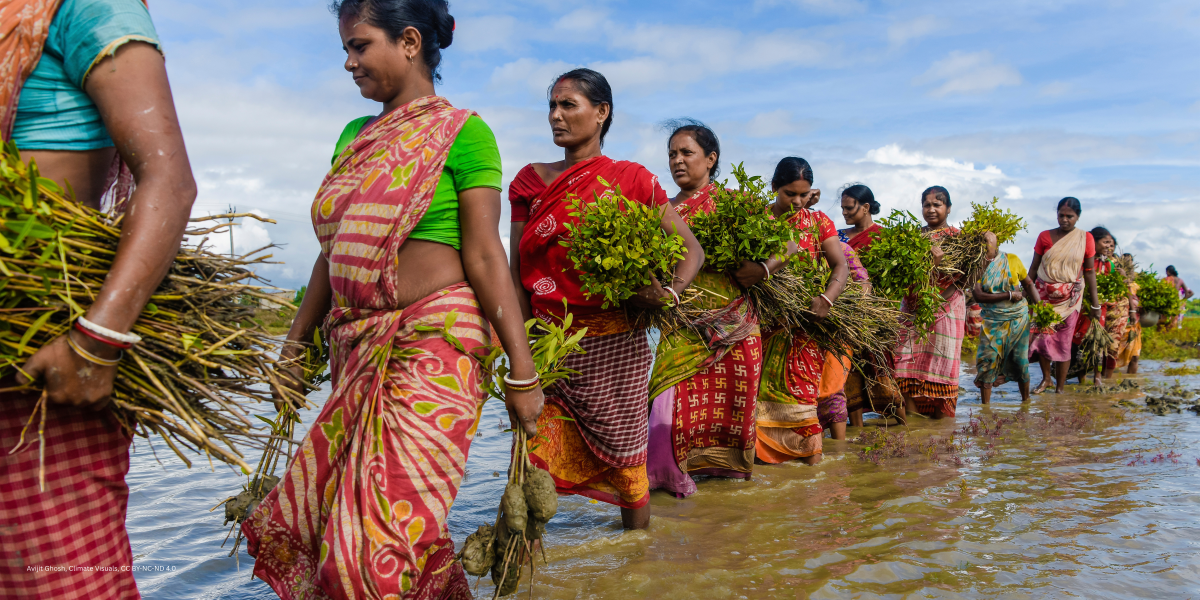
Lead photo image: Women are seen queueing up to plant mangrove saplings along the riverbanks of the Matla river in Sundarbans, India. Sundarbans is the world’s largest mangrove delta. Photo credit: Avijit Ghosh, Climate Visuals, CC BY-NC-ND 4.0.